
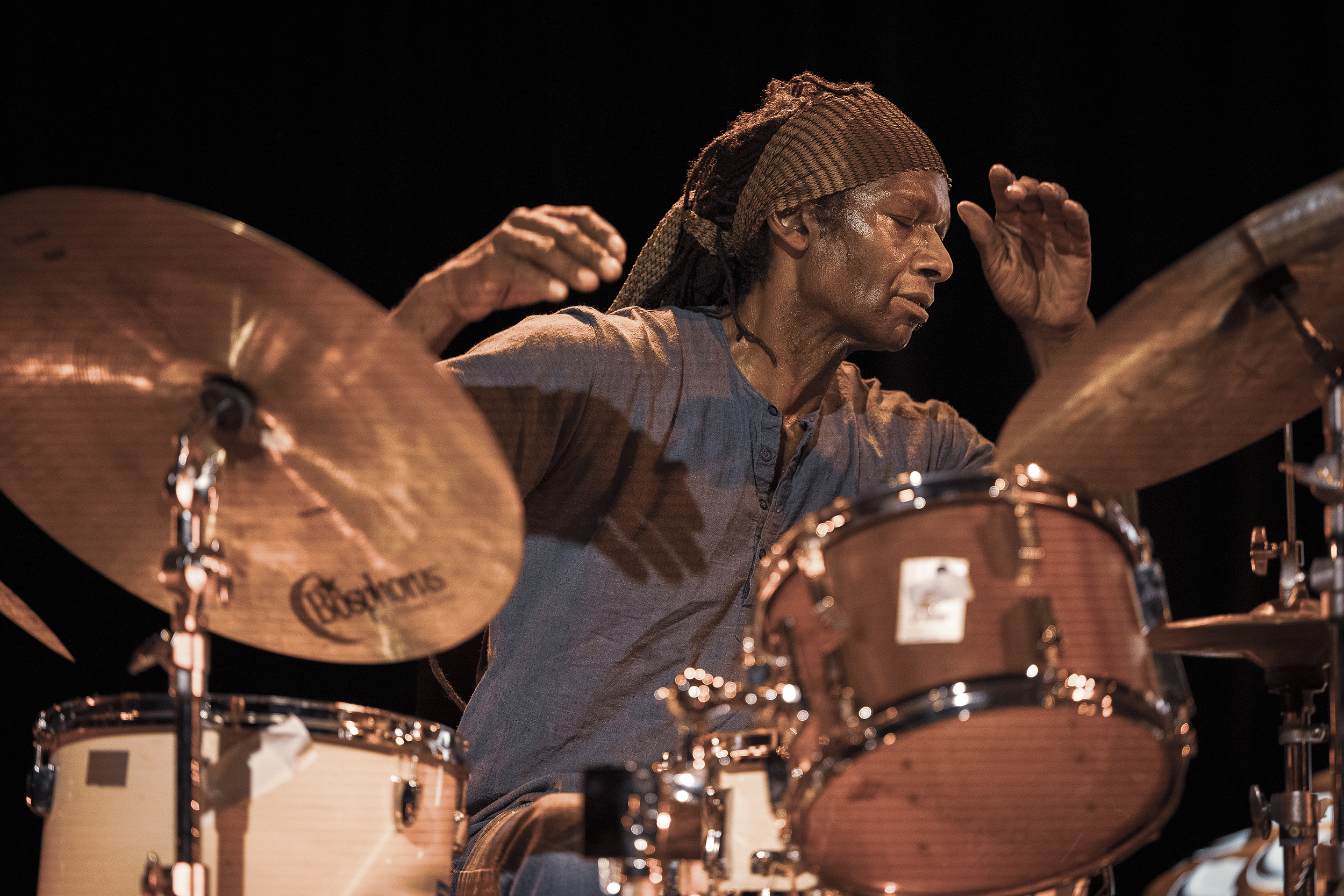
Hamid Drake
proprio mentre un altro musicista, faceva lo stesso tragitto, con la propria di famiglia: Fred Anderson. Hamid si è immerso fin da adolescente nell’ascolto R&B e funk, di tutto il Motown, Stax e Atco.
Ha iniziato a suonare in rock and R&B bands, ancor giovanissimo, attirando l’attenzione di Fred Anderson col quale dal 1974 in poi si instaura una collaborazione professionale che diviene sempre più stabile. È lo stesso Fred Anderson che lo introduce presso Douglas Ewart, Gerge Lewis e gli altri componenti dell’AACM ( Chicago’s Association for the Advancement of Creative Musicians). Le sue influenze musicali più significative per quanto riguarda le percussioni risalgono a quel periodo, ovvero ad Ed Blackwell, Adam Rudolph, Philly Joe Jones, Max Roach, Jo Jones.
Altro incontro fortunato è quello con Don Cherry da cui scaturirà un’altra avventura musicale duratura. Dopo aver conosciuto Don Cherry, Hamid ha viaggiato molto al suo seguito in Europa, occasione per dedicare più tempo all’esplorazione dell’infinito universo percussivo, condividendo profondamentecon Don Cherry il significato della spiritualità applicata alla musica e delle sue infinite possibilità di trasformazione ed evoluzione.
Negli anni è stato inventivo supporto ritmico di lungimiranti artisti tra cui Borah Bergman e Peter Brotzmann, con il quale ha suonato in quartetto con William Parker e Toshinori Kondo, Marylin Crispell, Pierre Dørge, il pianista compositore norvegese Georg Gräwe, Herbie Hancock, Misha Mengelberg, Pharoah Sanders, Wayne Shorter, Malachi Thompson, David Murray, Archie Shepp, Bill Laswell, Gigi, Herbie Hancock, Nicole Mitchell, Michel Portal, M. Zerang con cui celebra dal 1991 il Solstizio d’Inverno, Kent Kessler e Ken Vandermark nel DKV trio.
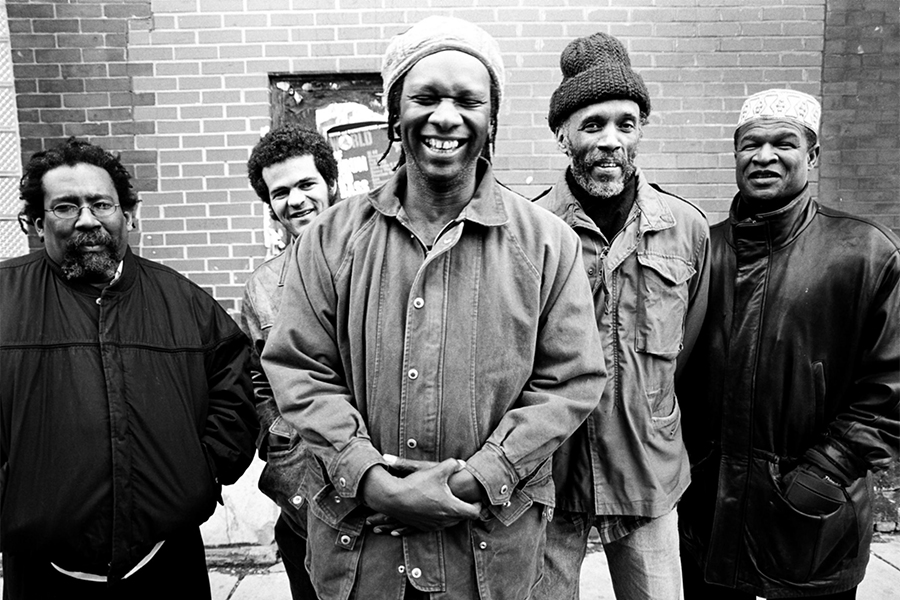
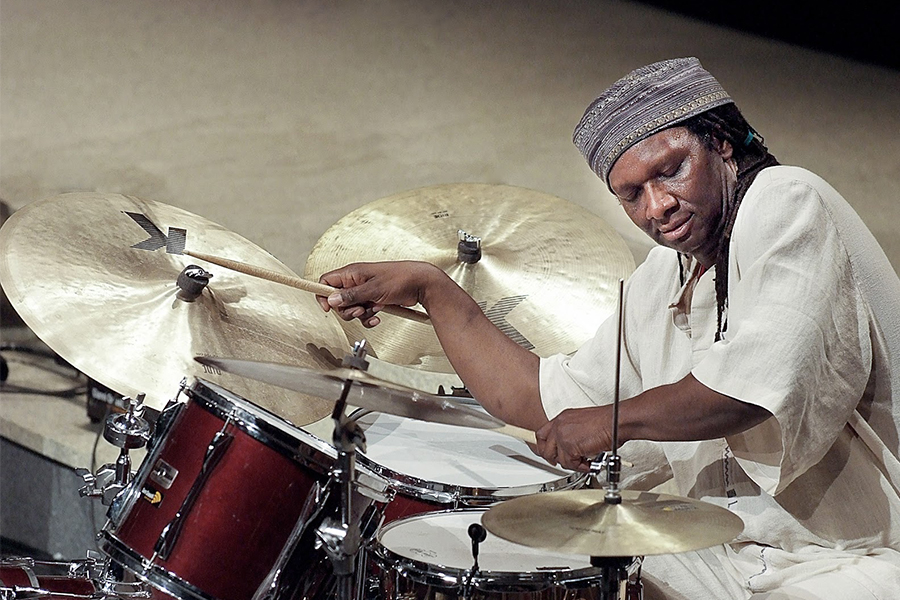

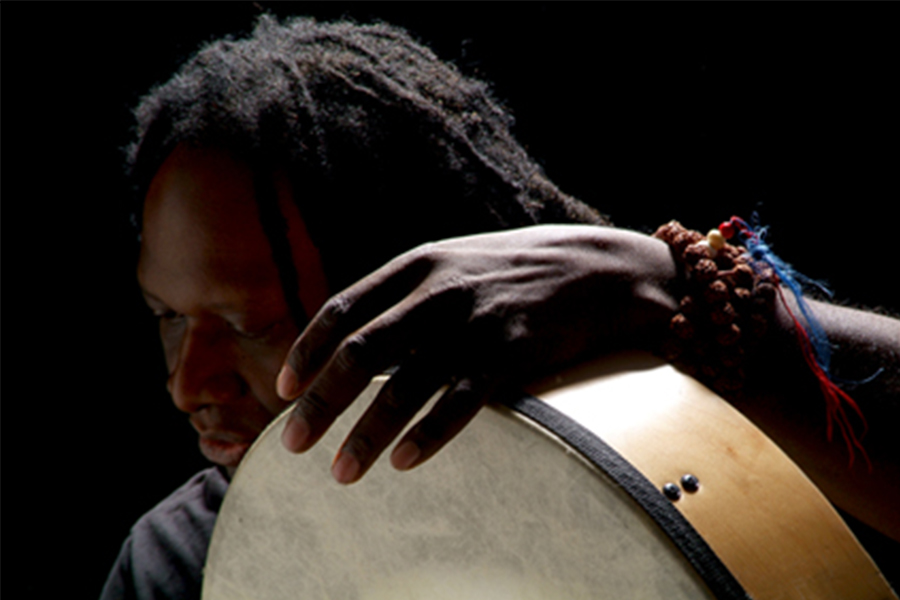


Negli ultimi anni nonostante i molteplici impegni di lavoro, dedica sempre più, parte della sua attività a progetti personali quali Bindu, Indigo trio (con Nicole Mitchell ed Harrison Bankhead) e collabora con alcuni tra i più interessanti musicisti del panorama europeo (P. Dunmall, Jan Bang, Erik Honorè, Eivind Aarset, Viktor Toth, Iva Bittova) italiano (Pasquale Mirra con cui ha un duo stabile dal 2008, Antonello Salis, Paolo Angeli e di recente Daniele Sepe).
Progetti
HAMID DRAKE’S TURIYA: HONORING ALICE COLTRANE
NDOHO ANGE: dance, spoken words, THOMAS DE POURQUERY: sax and vocals, JAN BANG: electronics JAMIE SAFT: piano, keyboard, Fender r, PASQUALE MIRRA: vibraphone, percussions JOSHUA ABRAMS: double bass, guembri HAMID DRAKE: drums, percussion, vocals
Hamid Drake pays homage to Alice Coltrane’s music with a group of top-notch international musicians + special guests Thomas de Pourquery &/or (sax, wood winds bamboo flutes) or Naissam Jalal flutes and vocals &/or Michiyo Yagi playing Koto
“I was 16 when I met Alice Coltrane at a concert in Ravinia Park, outside of Chicago. We exchanged addresses and wrote to each other afterwards. Her creativity impacted a host of musicians and listeners. For myself it was and still is very powerful. She gifted me with a spiritual and aesthetic openess that I continually cherish. This project is my way of honoring the great being that enabled the teenager to continue on the path of discovery, wonderment and finding one’s own voice”
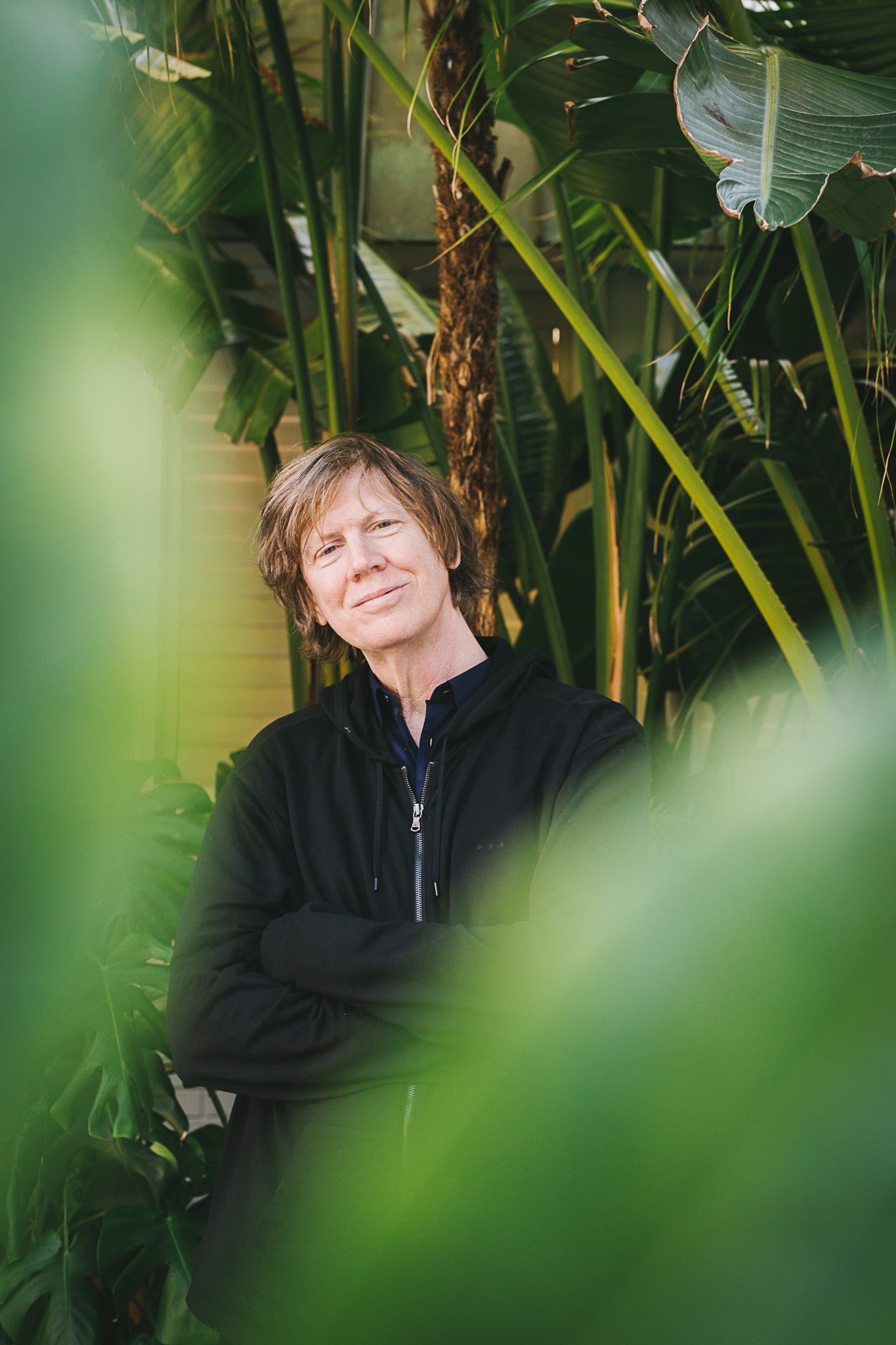
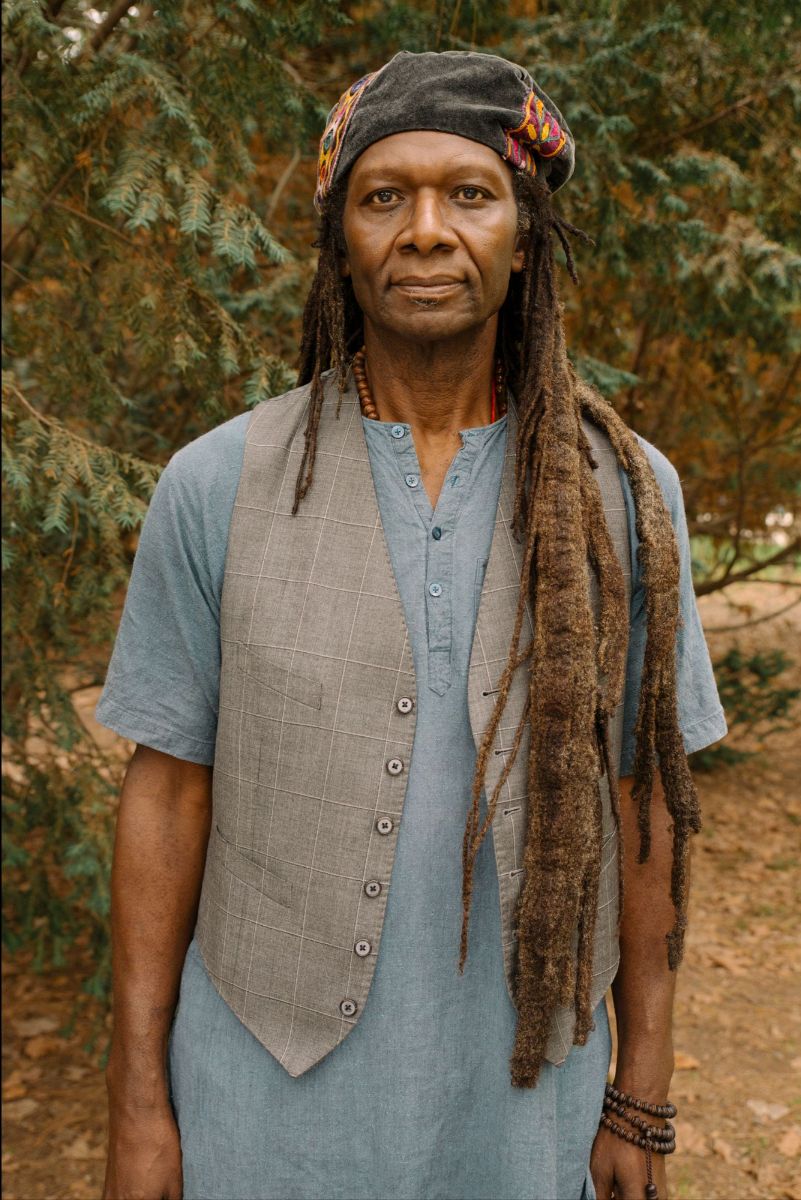
New project! HAMID DRAKE + THURSTON MOORE
New project! Teriya Quartet
Aly Keita, Hervé Samb, Brad Jones, Hamid Drake.
Creation Sons d’Hiver 01/19/2024.
“Some sounds give you the blues, others make you happy. Hamid Drake and Aly Keïta have heard and created some of these sounds in their lives, with some of the most interesting musicians in jazz and world music. In Bambara, Teriya means friendship. This is the name Aly and Hamid have given to the group they’ve brought together this evening. Friendship dances at the heart of the quartet they have imagined together. It’s also a return to the very roots of music: encounters, dialogue and unison. Sons d’Hiver loves these returns to basics. Faithful friends of the festival, Drake and Keïta have been bathing it in thought and wisdom for a long time. Sounds that comfort, sounds that inspire wonderment and enquiry. Sounds that create joy and bring people together.” Hamid Drake and Aly Keita embody the meeting between Africa and America, the drums and the balafon. Accompanied by Hervé Samb on guitar and Brad Jones on double bass, the four musicians showcase the creativity of their continents of origin. Their music covers a thousand rhythmic nuances, drawing inspiration from lullabies from the West African griot tradition, as well as motifs from African-American jazz.

XHOSA COLE / MAJID BEKKAS / HAMID DRAKE
Xhosa Cole. tenor saxophone, clarinet, flutes
Majid Bekkas, vocals, guembri, oud, electric guitar
Hamid Drake, drums, percussion, vocals
 Divination
 Divination
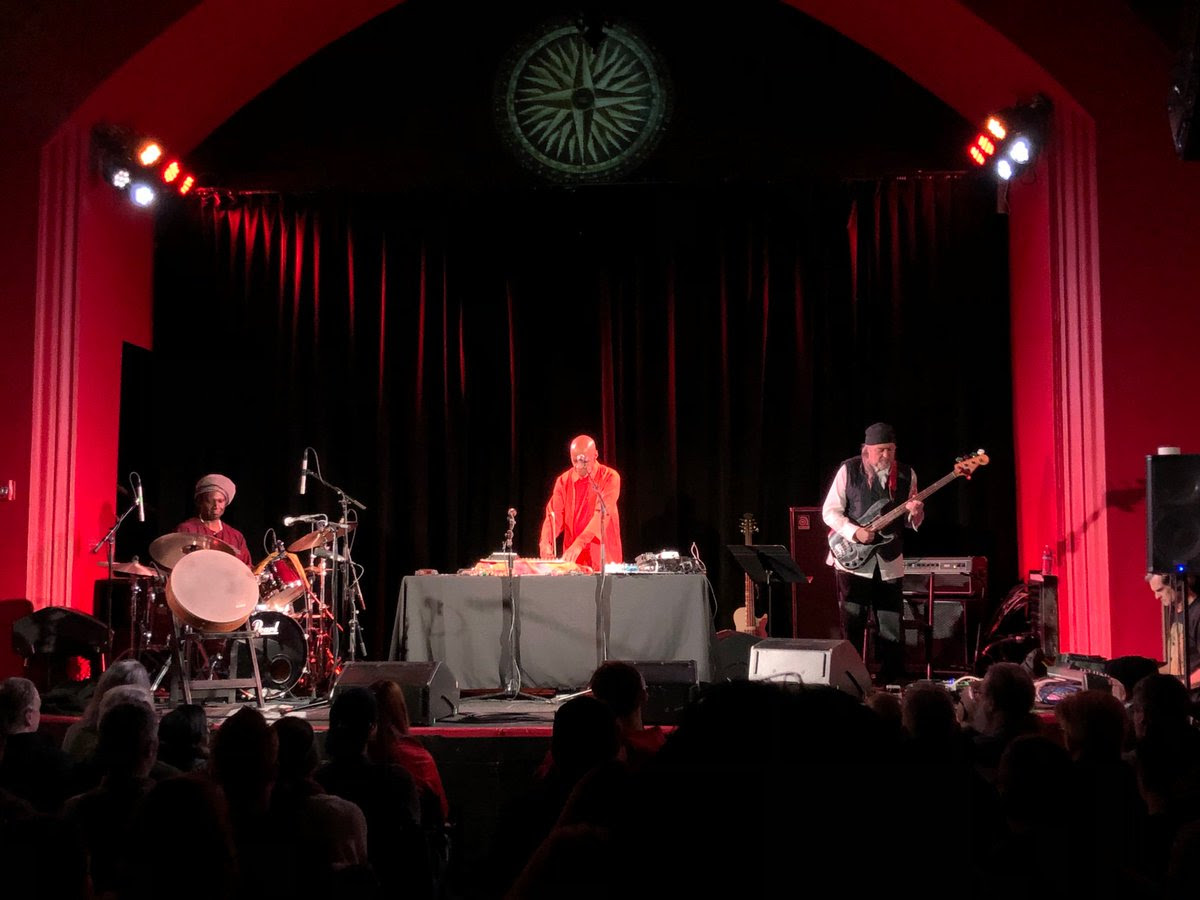
Laraaji (zither) / Bill Laswell (bass) / Hamid Drake (ds)
Bill Laswell (b. February 12, 1955 in Salem, Illinois and raised in Albion, Michigan) is an American bassist, producer and record label owner. He was married to Ethiopian singer Ejigayehu Shibabaw alias Gigi. Laswell ranks among the most prolific of musicians, being involved in hundreds of recordings with many musicians from all over the world. Laswell’s music draws upon many different genres, most notably funk, various world music, jazz, dub and ambient styles. He has also played or produced music from the noisier, more aggressive end of the rock spectrum, like hardcore punk and metal.
Hamid Drake & Bindu Reggaeology
While most listeners know Hamid Drake as one of jazz’s best percussionists, he also happens to be one of the finest reggae drummers. Before the demands of the road took him away from Chicago for much of the year, he worked with many local reggae outfits, and the music still courses through his veins. Drake has been using the moniker Bindu as the name for a variety of focus-shifting lineups, but the one that released Reggaeology (Rogue Art) in 2010 might be the most rewarding of them. As the name suggests, the project allows Drake to merge his deep investment in reggae with his mastery of improvised music.
The frontline features trombonists Jeb Bishop and Jeff Albert in a not so subtle to salute to the ubiquity of the instrument in Jamaican music—thanks to the brilliance Skatalites trombonist Rico Rodriguez—and guitarist Jeff Parker helps hold down the music’s infectious syncopated grooves while tracing out the chordal shapes (to say nothing of unleashing some typically corrosive solos) in Drake’s sturdy compositions. Still, Drake refuses to limit the band to just Jamaican music. Cincinnati poet and beatboxer Napoleon Maddox adds extra rhythms and delivers spiritual spoken word, while bassist Joshua Abrams connects with the drummer in a shared predilection for traditional global grooves, shifting to the bass-like Moroccan guimbri when Drake moves to frame drum. Finally, the powerhouse Chicago vibraphonist Jason Adasiewicz will also join the group.
Indigenous Mind
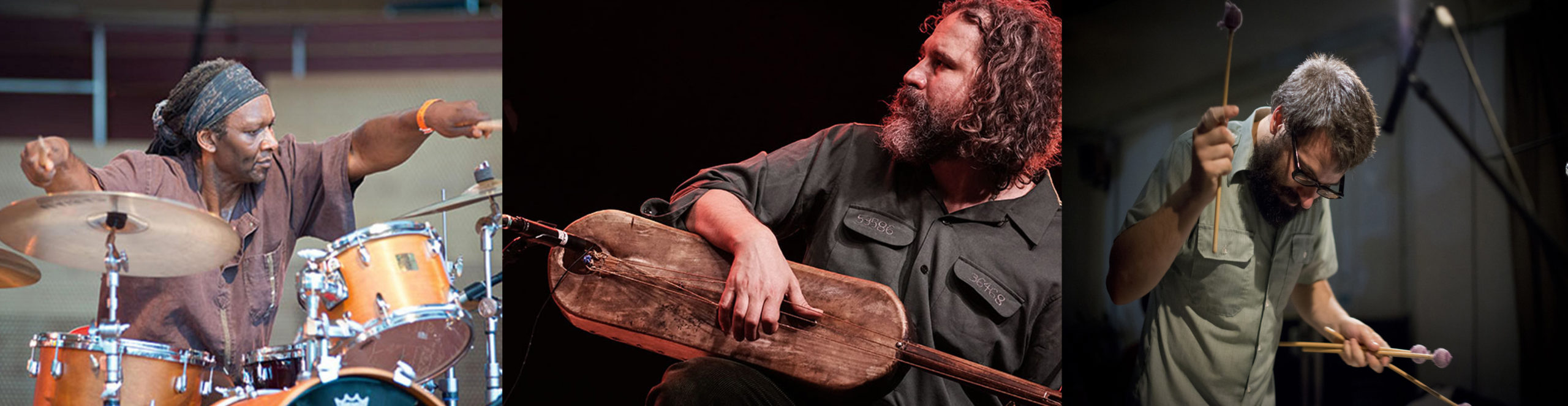
Hamid Drake – drums & percussion / Joshua Abrams – bass & guimbri / Jason Adasciewicz – vibraphone & balaph
Indigenous Mind may also be called Primordial Mind. It is something we all possess. It belongs to everyone and every culture at its root. Indigenous Mind, even though it is always present, still has to be discovered. We attempt to do that with music and art. Going beyond the illusion of performer and audience and allowing ourselves to enter, touch, feel, sense, and enjoy the oneness of the shared energy of open space.
Peter Brötzmann — Maâlem Moukhtar Gania — Hamid Drake
Peter Brötzmann – sax alto, sax tenore, clarinetto, tarogato / Maâlem Moukhtar Gania – guembri, voce / Hamid Drake batteria – percussioni / Musiche di Peter Brötzmann, Maâlem Moukhtar Gania, Hamid Drake
The Catch of a Ghost”

3 nomi, 3 culture, 3 continenti, 3 diverse concezioni di tempo e tempismo – questa è l’essenza di questo trio. Questo è ciò che dovremo mettere assieme. Sono abbastanza ottimista.” Peter Brötzmann, Wuppertal, 1 Aprile 2019
Con queste semplici parole Peter Brötzmann, uno tra i più importanti esponenti dello sviluppo di un approccio europeo unico alla libera improvvisazione fin dagli anni Sessanta, ha annunciato l’inedito trio formato per il suo ritorno al festival AngelicA nel 2019; trio che al fidato Hamid Drake – tra i migliori batteristi viventi e suo storico collaboratore fin dai tempi del Die Like a Dog quartet – ha affiancato Maâlem Moukhtar Gania, ultimo esponente di una leggendaria dinastia di maestri della musica Gnawa di Essaouira, figlio di Maalem Boubker Gania, e fratello del prematuramente scomparso Maalem Mahmoud Gania, che era stato protagonista con Brötzmann e Drake di un esplosivo trio a Wels nel 1996.
Il trio di Bologna documentato nel cd The Catch of a Ghost ha entusiasmato e sorpreso il pubblico presente per la grande energia e vivacità delle tessiture create dal dialogo tra i musicisti, ma anche per la continua capacità di (re)invenzione accoppiata a un’inesausta potenza fisica dell’emissione di Brötzmann, che ha mostrato a 78 anni di non avere niente da invidiare al suo sé degli esordi di 50 anni prima.
Label : I dischi di Angelica / In collaborazione con Francesca Scarinci Exb.