
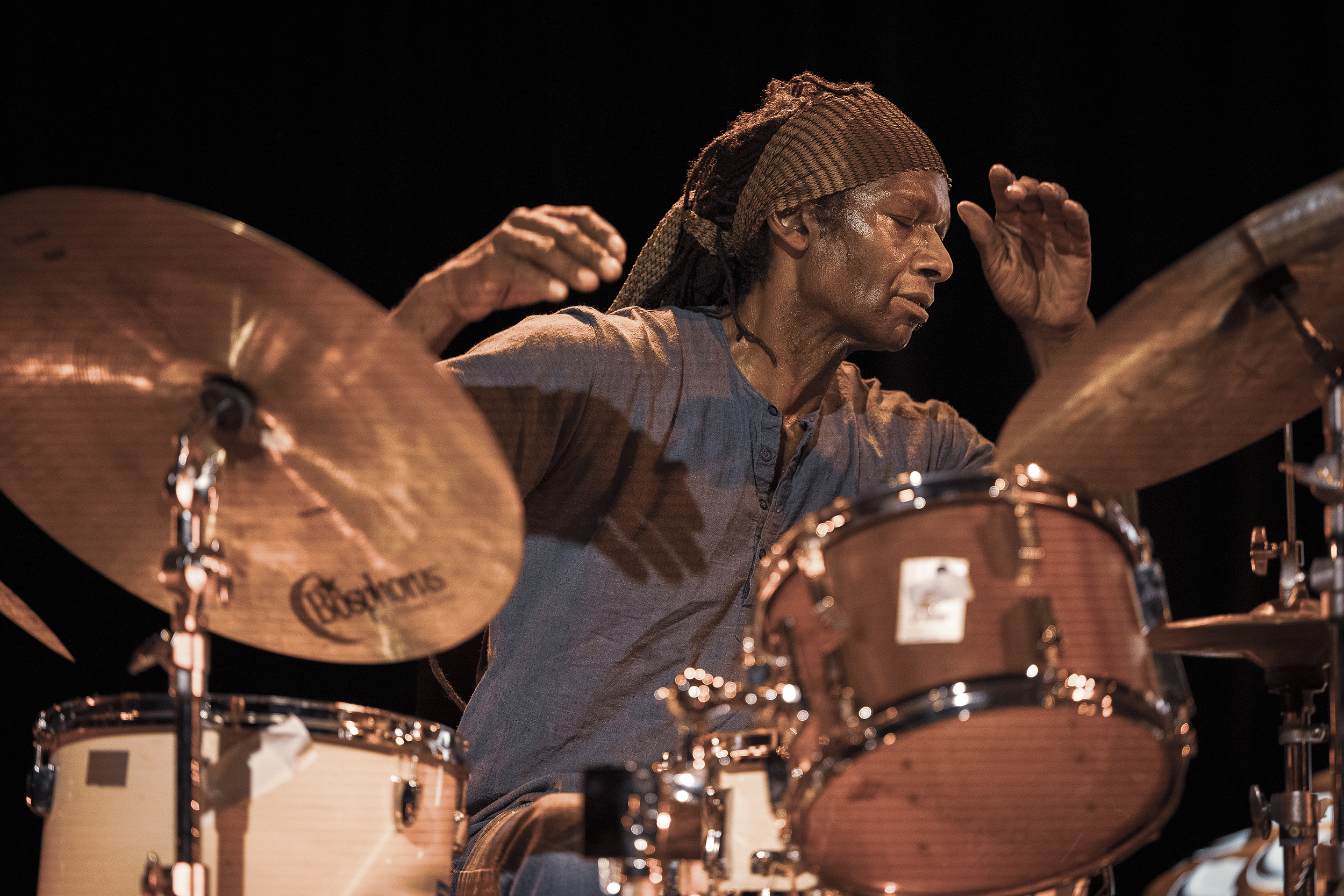
Hamid Drake
Drake worked with Anderson from 1974 to 2010 including on Anderson‘s 1979 The Missing Link. At Fred Anderson’s workshops, a young Hamid met Douglas Ewart, George Lewis and other members of Chicago‘s Association for the Advancement of Creative Musicians (AACM).
Another of the most significant percussion influences on Drake, Ed Blackwell, dates from this period. Hamid‘s flowing rhythmic expressions and interest in the roots of the music drew like~minded musicians together into a performance and educational collective named the Mandingo Griot Society, which combined traditional African music and narrative with distinctly American influences. Career. Don Cherry, who Drake first met in 1978, was another continuing collaborator. After meeting Don Cherry, Hamid and fellow percussionist Adam Rudolph travelled with Don to Europe, where they explored the interior landscape of percussion and shared deeply in Mr. Cherry‘s grasp of music‘s spiritually infinite transformational possibilities. Drake worked extensively with him from 1978 until Cherry‘s death in 1995.
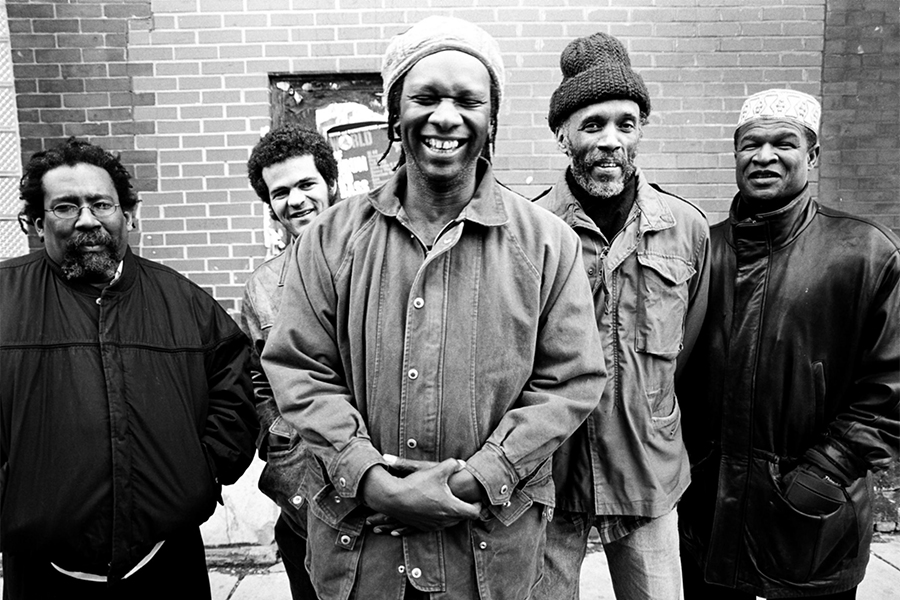
Drake was one of the founders, along with Foday Musa Suso and Adam Rudolph, of The Mandingo Griot Society. His other frequent collaborators include New York bassist William Parker, saxophonist David Murray, composer and percussionistAdam Rudolph, German free jazz saxophonist Peter Brötzmann and drummer Michael Zerang. Drake performing with Iva Bittová in Moscow in January 2014.
Now touring and recording all over the world and in constant demand everywhere, Hamid Drake has played and/or recorded with Don Cherry, Pharoah Sanders, Fred Anderson, Herbie Hancock, Archie Shepp, William Parker (in a large number of lineups), Reggie Workman, Yusef Lateef, Wayne Shorter, Bill Laswell, David Murray, Joe Morris, Evan Parker, Peter Brotzmann, Jim Pepper, Roy Campbella, Sabir Mateen, Rob Brown, Marilyn Crispell, Johnny Dyani, Dewey Redman, Joe McPhee, Adam Rudolph, Hassan Hakmoun, Joseph Jarman, George Lewis, John Tchicai, Iva Bittová and almost all the members of the AACM. These diverse artists all play in a broad range of musical settings which allows Drake to comfortably adapt to north and west African and Indian impulses as well as reggae and Latin. Although engaged as sideman, he is also devoting his energies and creativity as a band leader; focusing on his own groups and projects such as Bindu or Indigo Trio.
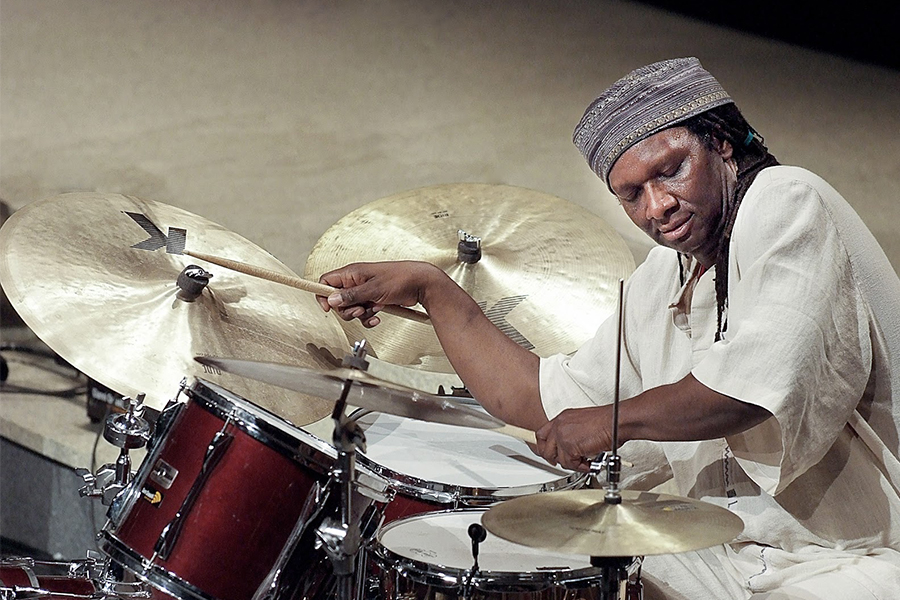
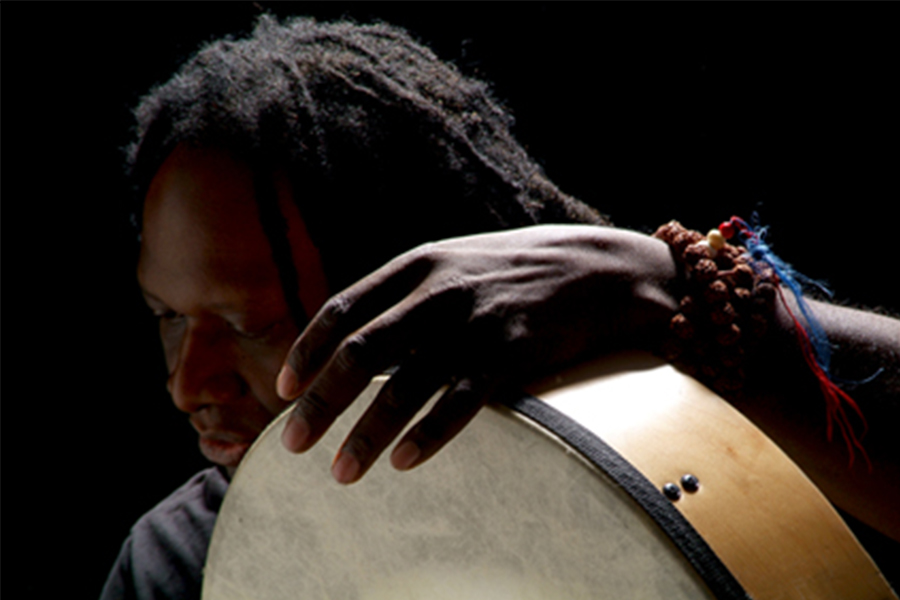
Drake has frequently appeared with jazz legend Archie Shepp in various configurations. The most common is the group Phat Jam along with human beat boxer and rapper Napoleon Maddox. Drake also works with Maddox in the jazz hip hop group ISWHAT?!. Drake performs with European jazz groups, recording with Hungarian musicians such as Viktor Tóth and Mihály Dresch, also releasing projects with Polish saxophonist Mat Walerian. In addition to the drum set, Drake performs on the frame drum, the tabla, and other hand drums.



Since 1990 Drake has collaborated with fellow percussionist Michael Zerang to present annual winter solstice concerts. For the past 25 years both musicians have been committed to return to Chicago, IL from wherever in the world they are performing to stage the event which commemorates the northern hemispheres shortest day. About the event Drake has said, “The solstice is an important time for all people of any religion or race, because it’s about the cycling of the earth itself, and nobody can really claim that. It’s a time of the year when a lot of people are home and visiting, and we wanted to create something that people would enjoy at that particular time, regardless of whatever they might be following. I think it just kind of naturally turned into this continuing event. I don’t think that we planned it at the beginning.”
Projects
Duet Shabaka Hutchings + Hamid Drake


Ph. Arnis Kalninš
A few minutes into Shabaka Hutchings and Hamid Drake’s set the pair hit a series of abrupt pauses, halting in momentary chasms of silence before restarting. They’re like inhalations of breath, as if the pair are slowly modulating our breathing to prepare us for the flow of sound they’re about to immerse us in. These fiendishly tight pauses also establish a seemingly telekinetic connection between the two, Hutchings, a London-based composer who leads Shabaka and The Ancestors and is a former member of the Comet Is Coming and Sons Of Kemet, and Drake, a veteran percussionist who’s played with everyone from Don Cherry to Herbie Hancock, have an instantaneous familiarity. Once that connection is tuned in, they enter a gorgeous flow state, one which has a surprisingly prominent amount of saxophone in it considering Hutchings’ recent focus on flutes. Here, he alternates between sax, a wide selection of flutes and onto shimmering electronics, situating the music on the line bridging Alice Coltrane to Pharoah Sanders (who Drake collaborated with) while deftly bypassing the cloying new age excesses artists working in that space can risk falling into. Drake’s drumming has the force and fluctuation of a waterfall, relentlessly tethered to the gravity of a groove but twisting and bending his playing to turn rhythms on their head. There’s a liquid instability, at points he drops abrupt changes of pace while never losing the forward flowing momentum, tempo changes arriving like bends in a river the music flows around. At the start most of the audience are sat on chairs or lying on the floor. By the end, when Drake moves to the front of the stage, playing a single drum and singing, a crowd is dancing, the floating quality of their music filtering into the audience and levitating the room.
Joan La Barbara, Seven Highlights From Skaņu Mežs Festival 2025
Trio Shabaka Hutchings + Hamid Drake + Majid Bekkas

HAMID DRAKE’S TURIYA: HONORING ALICE COLTRANE
NDOHO ANGE: dance, spoken words, THOMAS DE POURQUERY: sax and vocals, JAN BANG: electronics JAMIE SAFT: piano, keyboard, Fender r, PASQUALE MIRRA: vibraphone, percussions JOSHUA ABRAMS: double bass, guembri HAMID DRAKE: drums, percussion, vocals
Hamid Drake pays homage to Alice Coltrane’s music with a group of top-notch international musicians + special guests Thomas de Pourquery &/or (sax, wood winds bamboo flutes) or Naissam Jalal flutes and vocals &/or Michiyo Yagi playing Koto/ Sheila Maurice-Grey, trumphet and vocals
“I was 16 when I met Alice Coltrane at a concert in Ravinia Park, outside of Chicago. We exchanged addresses and wrote to each other afterwards. Her creativity impacted a host of musicians and listeners. For myself it was and still is very powerful. She gifted me with a spiritual and aesthetic openess that I continually cherish. This project is my way of honoring the great being that enabled the teenager to continue on the path of discovery, wonderment and finding one’s own voice”
DKV Trio
Hamid Drake drums, Ken Vandermark (clarinet and tenor sax), Kent Kessler (bass)
Hamid Drake / Ava Mendoza Duet

Ancient to the future
Hamid Drake, Xhosa Cole, Ava Mendoza, Majid Bekkas
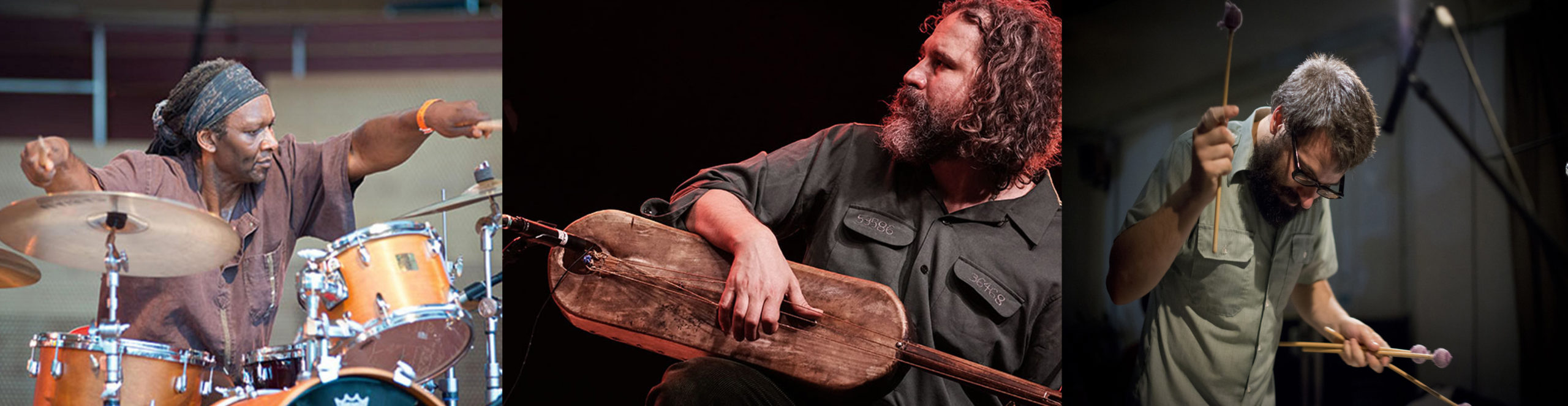
Indigenous Mind
Hamid Drake – drums & percussion / Joshua Abrams – bass & guimbri / Jason Adasciewicz – vibraphone & balaph
Indigenous Mind may also be called Primordial Mind. It is something we all possess. It belongs to everyone and every culture at its root. Indigenous Mind, even though it is always present, still has to be discovered. We attempt to do that with music and art. Going beyond the illusion of performer and audience and allowing ourselves to enter, touch, feel, sense, and enjoy the oneness of the shared energy of open space.